 This weekend, May 22/23, is the beginning of a huge 4-day holiday celebrating the bicentenary of Argentina's Revolution of 25 May, 1810 that resulted in the breaking of colonial ties with Spain, paving the road to independence on July 9, 1816. The 'widest road in the world', av 9 de julio (obelisk at the end), has been cordoned off and is teaming with people and parades, live music and exhibits showing the different provinces of Argentina.
Showing posts with label Buenos Aires. Show all posts
Showing posts with label Buenos Aires. Show all posts
Sunday, 23 May 2010
Bicentenary Celebrations
This weekend, May 22/23, is the beginning of a huge 4-day holiday celebrating the bicentenary of Argentina's Revolution of 25 May, 1810 that resulted in the breaking of colonial ties with Spain, paving the road to independence on July 9, 1816. The 'widest road in the world', av 9 de julio (obelisk at the end), has been cordoned off and is teaming with people and parades, live music and exhibits showing the different provinces of Argentina.

La Galeria Pacifico

 This shopping mall on Florida Street was modelled after Le Bon Marche in Paris with beautiful frescos in the cupola. The mall houses many high-end stores such as Tiffany's, Ralph Lauren, Christian Lacroix, Christian Dior, Lacoste and Tommy Hilfigger. It also has a tango school and this is where I've been coming for classes.
Retiro Railway Station

 At the turn of the 20th century, Argentina had vast natural resources such as grain and cattle waiting to be exploited, but it was the British Empire that had the investment capability and technology to create this Retiro railroad station complex and connect Buenos Aires to the hinterlands in order to get its products to overseas markets. Most of the railway stations here were built by the British and they're all examples of stunning Victorian architecture.
Empanadas
 I'm eating far too many of these! Like miniature Cornish pasties, empanadas are delicious snacks sold everywhere. The name comes from the verb empanar, meaning to wrap or coat in bread and the stuffing inside is usually meat, but there's also tuna, chicken, vegetable or ham and cheese.
British Clock Tower
 This Elizabethan-style clock tower, which some call the Argentine Big Ben, was a gift from the British community of Buenos Aires. After the war in the Falklands, anything associated with Britain was renamed and the tower became Torre Monumental, although nearly all locals still call it the British Clock Tower. The monument survived the war unscathed, but a few years later during an anniversary memorial service, an angry mob attacked it. They destroyed portions of the base and also toppled a statue of George Canning, the first British diplomat to recognize the country's independence from Spain (he's now safely kept at the British Embassy).
Recoleta Cemetery

This is a famous cemetery located in the exclusive Recoleta neighbourhood of Buenos Aires. It houses graves of some of the most influential and important Argentinians, including several presidents, scientists or just very wealthy people. Eva Perón and Raúl Alfonsín are buried here. The entire cemetery is laid out in sections like city blocks with wide, tree-lined main walkways branching into narrower ones filled with mausoleums. Each one bears the family name etched into the facade with the death date but no birth date.
Kavanagh Building
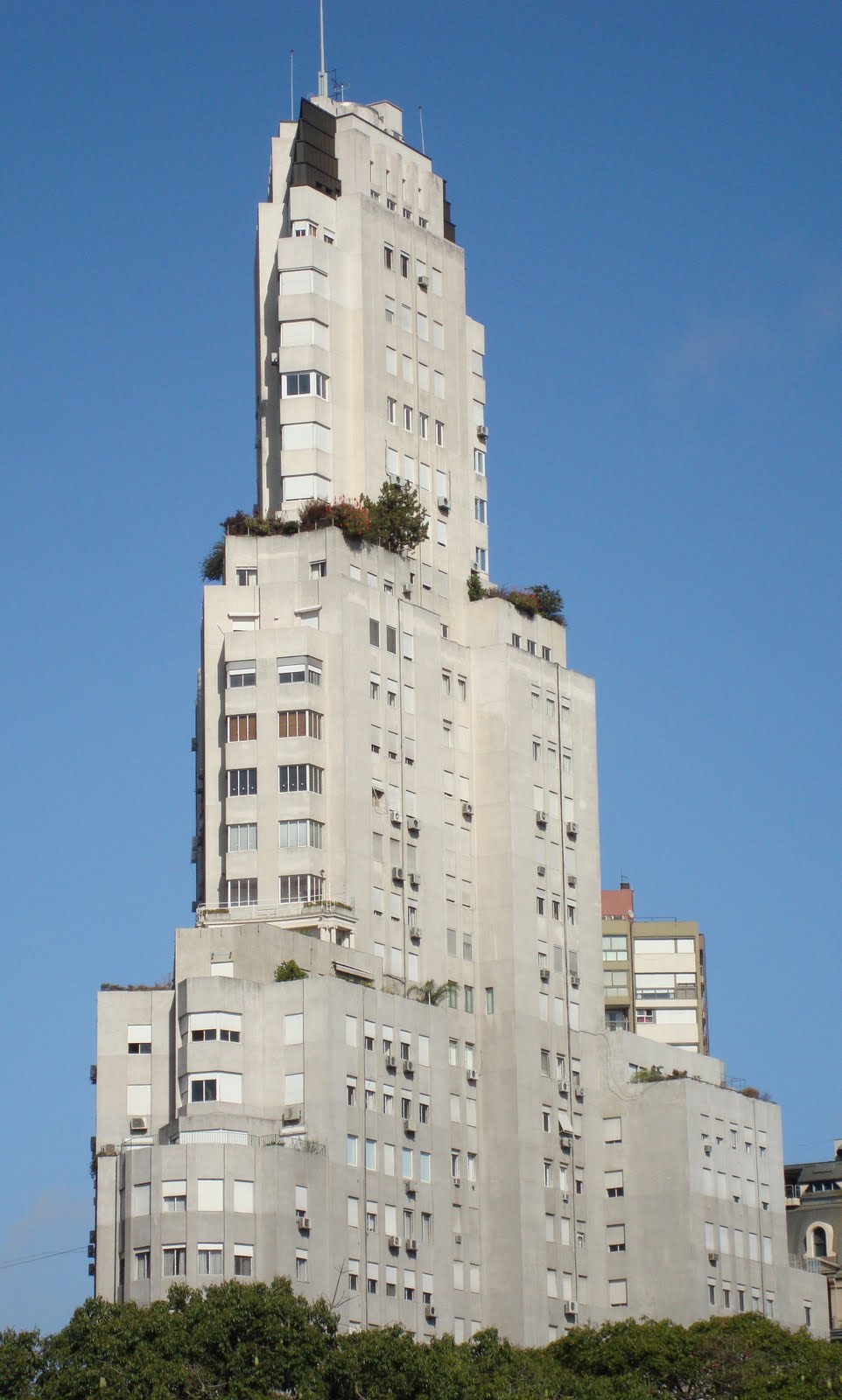 Built in 1936, the Kavanagh building was financed by Corina Kavanagh, one of Argentina’s wealthiest women at the time, who invested all she had inherited and sold all her other properties to build this, her very own skyscraper. Designed to be as slender as possible in order to avoid unnecessary weight, the building is considered to be the apex of early Modernism in Argentina.
At the time it was highest reinforced concrete structure in the world and the tallest building in South America for many years. Those on the upper floors have exquisite terrace gardens with views of the river, parks and the city. Corina Kavanagh lived for many years on the 14th floor in the largest apartment, the only one that occupies an entire floor.
As the story goes, the shape of the building was also designed as a revenge. One of Corina's daughters, who was wealthy but not aristocratic, fell in love with the son of the Anchorena family, who were both wealthy, aristocratic and lived in a palace. They disapproved of the engagement and had built a church next to the site of the Kavanagh Building. In revenge, Corina decided to build a skyscraper that would block the view of the church from their palace.
Saturday, 22 May 2010
Avenida 9 de Julio
 Argentina boasts not only the widest river (Rio de la Plata) but also the widest avenue in the world, avenida 9 of julio. It consists of 3 major carriageways of 6 lanes each and a road each side with 2 lanes, making 21 altogether...tough to cross in one go.
Teatro Colon

This is one of the world's great opera houses - the interior is resplendent with red plush and gilt, the stage is huge, and salons, dressing rooms and banquet halls are equally sumptuous. A full building restoration has just been completed.
Yerba Mate

Just as we love our cups of tea, the Argentinians love their yerba mate, an infusion prepared by steeping dry leaves (and twigs) in hot water (not boiling). It's drunk from these hollow gourds with a metal straw and the flavor is strongly vegetal, herbal and grassy, reminiscent of some varieties of green tea. Some consider the flavor to be very agreeable but it's hard to beat a cup of Tetley's.
Museo del Cabildo
 In this old Cabildo, the movement for independence from Spain was first planned. It's worth a visit for the paintings of old Buenos Aires, the documents and maps recording the May 1810 revolution and memorabilia of the 1806 British attack.
Palacio del Congreso (Congress Hall)

This huge Greco-Roman building houses the seat of the legislature. I haven't taken a tour of the inside yet but you need your passport to enter.
Plaza de Mayo

This is the heart of the city where the Mothers and Grandmothers of the Plaza de Mayo march in remembrance of their children who disappeared during the 'dirty war' of the 1970's - they march anti-clockwise round the central monument (under renovation at the moment) every Thursday at 3.30pm with photos of their disappeared loved-ones pinned to their chests.
City Bus Tour

A great way to see the city sights is with this open-air, hop-on hop-off bus which takes about 2 1/2 hours. The capital has been virtually rebuilt since the beginning of the 20th century and its oldest buildings mostly date from the early 1900's with some elegant examples from the 1920's and 1930's. The centre has maintained the original layout since its foundation and so the streets are often narrow and mostly one-way.
Monday, 17 May 2010
Cartoneros
 There's no official recycling system here so every evening in the streets these cartoneros sift through people's rubbish (no gloves!) picking out cardboard, tins and bottles (not plastic) which they take to a recycling centre where they receive remuneration. I often saw women sitting in the street surrounded by mountains of black plastic rubbish bags going through each one, and young girls and boys pulling carts like this without the help of a horse. How much easier it would be for them if people put the recyclable stuff in separate bags!
San Telmo

 The streets of San Telmo are narrow and cobbled and many of the colonial houses have been turned into restaurants and tango houses. That's a picture of Che Guevara on the wall - he was an Argentine Marxist revolutionary, physician, author, guerrilla leader and major figure of the Cuban Revolution.
This guy fancied himself as the famous tango singer, Carlos Gardel - he might've had the looks but he certainly didn't have the voice.


San Telmo
 One of the few areas which still holds the charm of its colonial past is this barrio of San Telmo, an atmospheric place with lots of cafes, antique shops and little art galleries. I went on Sunday when it comes alive with live music, free tango shows and street entertainers. There are hundreds of stands offering a huge variety of antiques and souvenirs, from mantillas and embroideries to vinyl records and phonographs.
Saturday, 8 May 2010
Tango Show (22 secs)
The exact origins of tango are lost in myth but the generally accepted theory is that in the mid-1800s, African slaves were brought to Argentina and began to influence the local culture. The word tango was the place where African slaves and free blacks gathered to dance.
Argentina was undergoing a massive immigration during the late 1800s and early 1900s. The intermixing of African, Spanish, Italian, British, Polish, Russian and native-born Argentines resulted in a melting pot of cultures and each borrowed dance and music from one another.
Most immigrants were single men hoping to earn their fortunes in this newly expanding country. They were typically poor and desperate, hoping to make enough money to return to Europe or bring their families to Argentina. The evolution of tango reflects their profound sense of loss and longing for the people and places they left behind.

Subscribe to:
Posts (Atom)